About 18 months ago, Rob Vangansewinkel’s Ideas submission based on a capsule toy vending machine was accepted. Today the final model has been revealed, and it is sure to excite many members of the broader LEGO community.
While the Vending machine is the primary build, fans are more likely to be distracted by the 16 minifigures encapsulated within. This set will be released on the 1st of June to LEGO Insiders and has a retail price of $AUD249.99 / €169.99 / £ 149.99 / $ 179.99.
In which we look at the figures in the build a ministations, compare theme with their existing counterparts and speculate over the next colour of spaceman torso. I think the clues are all there…
While LEGO® Dreamzzz sets focus mainly on the Dream World, a significant part of the action takes place in the waking world: the schoolyard, the kids’ homes and other locations around LEGO Brooklyn. It has been a little frustrating, being unable to get the right minifigures for these settings, until now…
Now that December is under way, German retailers Lucky Bricks and JB-Spielwaren have unveiled the majority of releases for January 2024 (and just a couple for March 2024 as well). The LEGO Builder App has got in on the act with these reveals as well, and there seems to be a recurring theme: SPACE. I was a childhood Space fan, and LEGOLAND Space with its red and white astronauts tickled my interest in just the right way back in 1979. Fast forward to 2024 and we see sets featuring LEGO Space Branding on the box, but also across multiple themes. How wide spread? We have seen it across not only City, but also Technic, Duplo, Dreamzzz, Friends, Creator 3in1 and Classic.
The branding takes the form of a diagonal silver cutoff, featuring the Classic Space LOGO with a purple planetoid and a red shuttle swooshing around it, and appears across the featured themes.
As a kid growing up in the 70s, I was a little excited about the idea of space travel. I missed the moon landing: The Apollo programme had drawn to a close, Skylab was preparing to burn up in the atmosphere above Western Australia, and we were eagerly awaiting the arrival of the Next Big Thing in space travel – the Space Shuttle.
And so it is into this milieu that as LEGO® Minifigures were unleashed on the world, that we had worlds of Castle, Town and Space unleashed on the world. Past,Present and Future. One had a passing interest, one was the mundane and every day and the other captured my imagination from the moment I saw the catalogue that read “… coming in 1979.” I may not have had many space sets as a child, but the ones I had I could still assemble by heart after 40 years, as I emerged from my dark ages and returned to my childhood LEGO Collection. Of course, while 1979 was the release date in Australia and Europe, a limited range was released in The USA in 1978.
As I have continued to explore the worlds of LEGO Classic Space and beyond, I have seen it through old catalogue scans, battered box photos and crumpled, stained instructions, while cleaning the dust and grime off bulk lots of elements, assembling weathered spacemen and wondering if I need to get my glasses cleaned.
When I saw early mentions of Tim Johnson’s book “LEGO Space: 1978-1992” turning up for preorder on Amazon, I was excited. Tim is a passionate fan who grew up in a similar era to myself and, as a self confessed parts nerd and founder of the website NEW ELEMENTARY, he was always going to bring some interesting insights to the project.
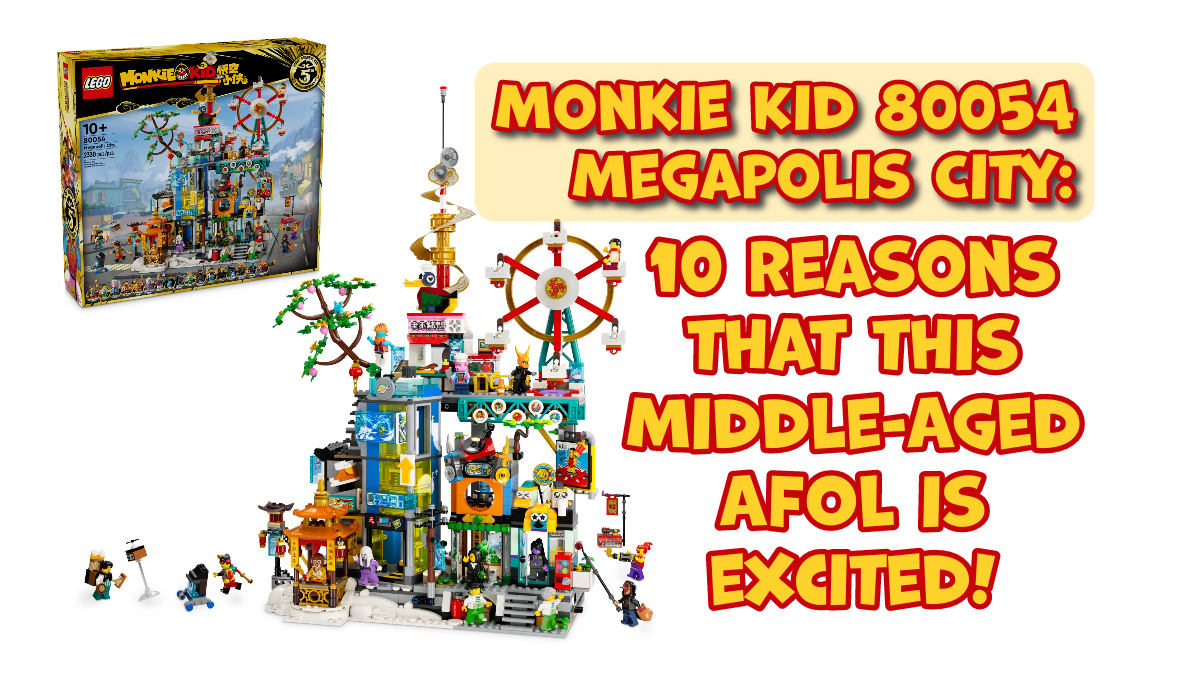
Yesterday, I was a little bit excited to get my first glimpses of the Monkie Kid set 80054 Megapolis City. Celebrating the 5th year of Monkie Kid, the set is full of the eastereggs that we have come to expect from these large scale urban envoronments from MK. But the image quality was a bit poor: fast forward 24 hours and we have now got high resolution images, some are ‘lifestyle images,’others are renders of the box art. And while I was a bit excited yesterday, today I am turning it up to 11.
I’ve just finished watching the first wave of episodes of Dragons Rising, and something struck my mind: Rapton, Lord Ras, and the Imperium Claw soldiers all fly the same type of small craft- a so called Chariot – which carries one rider and deploys a flotilla of drones to aid the hunters in their hunt for Dragons. That said, in the sets related to the series, the chariots are all a bit different to each other. At the same time they seem just a little bit familiar. And then there are the droids in the Dragon Power Spinzitzu sets…
And it got me thinking. Are these sets revisiting Classic Space, with a contemporary aesthetic?
If you have been following us on instagram lately you may have encountered the 90th Aniversary Habitat/MOPs Classic Themes challenge that we have been running in conjunction with Jen @brickfambuilds. The challenge closed this week, and I’d encourage you to checkout the submissions over there following the tags #lego90habitats and #rambling90years in closer detail.
Welcome back to the fifth instalment as we take a decade by decade look at the history of the LEGO Group, before they celebrate their 90th Anniversary on August 10, 2022. Last time, we left the 1960s behind: wheels and trains have entered the mix, and DUPLO is helping little people to build big things. Today, we move further into the ‘70s: an era where characters enter the mix, more realistic models are possible, and a new CEO enters the mix.
When I first saw images of the new 10497: Galaxy Explorer, while preparing for LEGO Con, I found myself both a little excited and apprehensive. Excited because, like many LEGO Space Fans of a certain age, this set told us that the LEGO Group recognises the importance of Classic Space to its older fans, and there had been so much clamouring for proper Space Sets: sets not tied in with different third party licences like Super Heroes or NASA, and not linked into the increasingly complicated lore behind Monkie Kid and Ninjago. We have seen sets buying into the idea of Classic Space – exploration, team work, free of conflict – in LEGO City over the years, BUT while there might be ‘equivalent’ sets, they strive to be too realistic- insisting on putting visors on every helmet, windows and air lock doors on the moon base and insisting on astronauts only being able to drink a cup of coffee when in their standard overalls. So, to see the look of Classic Space preserved and revisited is more than welcome.
In the previous article in this series, we looked at Classic Space – and what might define the theme: More than the colours, the sets of this era were united in working together for a common goal: exploring, mining and drinking oversized cups of coffee, while wearing their spacesuits inside. We have ships, bases and rovers, with a variety of colour schemes passing by over the years.
By the time I got to 1987, I had completed school, and was just starting off at university. My brother had recently stopped playing with our bricks, and they were put into storage – to be retrieved as we both gained children of our own. I was well and truly into my Dark Ages. All I know has been derived from fellow AFOLs, catalogs, the brickset database and picking up the occasional set or three along the way.