Is Ninjago Dragons Rising Updating Designs From Classic Space?

I’ve just finished watching the first wave of episodes of Dragons Rising, and something struck my mind: Rapton, Lord Ras, and the Imperium Claw soldiers all fly the same type of small craft- a so called Chariot – which carries one rider and deploys a flotilla of drones to aid the hunters in their hunt for Dragons. That said, in the sets related to the series, the chariots are all a bit different to each other. At the same time they seem just a little bit familiar. And then there are the droids in the Dragon Power Spinzitzu sets…

And it got me thinking. Are these sets revisiting Classic Space, with a contemporary aesthetic?

Continue reading

Are LEGO® Plastic Bags Waterproof? Stress Testing Internal Plastic Bags II

A couple of weeks ago, I subjected some of the forthcoming internal paper bags to some stress testing, to see if they were going to withstand travelling in a ‘deboxed’ fashion, as well as holding together while soaking in water. The bags held together, but waster certainly got into the bags, and I drew the conclusion that the bags were likely to be typically fit for purpose, but might not stand up to floodwaters in the way that plastic bags might.

Readers Sue Ann and Trevor got in touch, and suggested that I might be overselling the ability of the plastic bags to protect the LEGO® elements from flood waters (with their associated stink and filth). And so, I put them to the test.

What did I do? And how did they perform? Read on, after the break

Continue reading

We Stress Test the New ‘In Box’ Paper Bags

At the recent Recognised LEGO® Fan Media Days, we were treated to a presentation by the sustainability team with regard to progress being made on their various programs. The first part if the presentation was from Therese Noorlander, Senior Director of Sustainability Engagement. She spoke about some of the history of sustainability withing the LEGO Group – taking it back to the the Great Yo-Yo Craze of the 1930s: when the craze ended, leaving the company with boxes of unsold yo-yos, they were cut in half and used as wheels for toy wooden trucks, through to the ongoing research with regard to finding a sustainable material to use for plastic bricks. Most of this information has been published previously, and can be found on the LEGO Group’s sustainability website.
However, some of the most exciting news, not previously covered elsewhere, came from Anne Boye Møller, who for the past four years has been the Project Lead for the sustainable prepack. She works with a team based in Denmark and the Czech Republic and was proud to announce that the first generation packing lines are ready to go, and some of the first SKUs(sets) have been packed using these paper bags.

Continue reading

Classic Themes: Defining Classic Castle

In which we explore the early days of LEGO® Castle, take in the early factions, and look at just what made Castle sets ‘Classic Castle’

Over the past 18 months, the Rambling Brick has looked at the development of Classic Town from the early days, through the System era, a World City inspired Dark Ages to LEGO® City we know today. We have followed this up with a look at Classic Space, and its evolution through to the turn of the century. There is still an article to follow up here, looking at space themes in the 21st Century, and where they are today. This is particularly pertinent, given the 2022 reimagining of the original LEGO Space Flagship set: the 928/497Galaxy Explorer. This is not that article.

Before I write that article, for reasons that will eventually become apparent, I would like to take a look at the other pillar of the Classic LEGO Minifigure Themes – Castle. While Town gave kids the chance to live out the present, and space allowed them to imagine the Future, Castle allowed then to explore the past.

As a kid growing up in Australia, castles were a thing of fantasy: we only really saw them in books (with drawings) and in movies or on television. Typically in the context of an episode of Doctor Who. While the country has been inhabited for tens of thousands of years, the need for permenant fortifications was never really needed. In fact, the only castle I am aware of in Australia was built in the early 1970’s and run as a theme park.

But what are the characteristics of Classic Castle? And what time frame might be considered ‘Classic’? In this post, we will look at: Castle inspiration before minifigures existed; the initial range of Castle sets (1978-1981), and finally, consider Castle sets throughout the rest of ‘LEGOLAND’ phase: 1984-1990.

Continue reading

The Age Of LEGO® Space Factions: 1987-1999

In the previous article in this series, we looked at Classic Space – and what might define the theme: More than the colours, the sets of this era were united in working together for a common goal: exploring, mining and drinking oversized cups of coffee, while wearing their spacesuits inside. We have ships, bases and rovers, with a variety of colour schemes passing by over the years.

By the time I got to 1987, I had completed school, and was just starting off at university. My brother had recently stopped playing with our bricks, and they were put into storage – to be retrieved as we both gained children of our own. I was well and truly into my Dark Ages. All I know has been derived from fellow AFOLs, catalogs, the brickset database and picking up the occasional set or three along the way.

Continue reading

Classic themes: Defining Classic Space

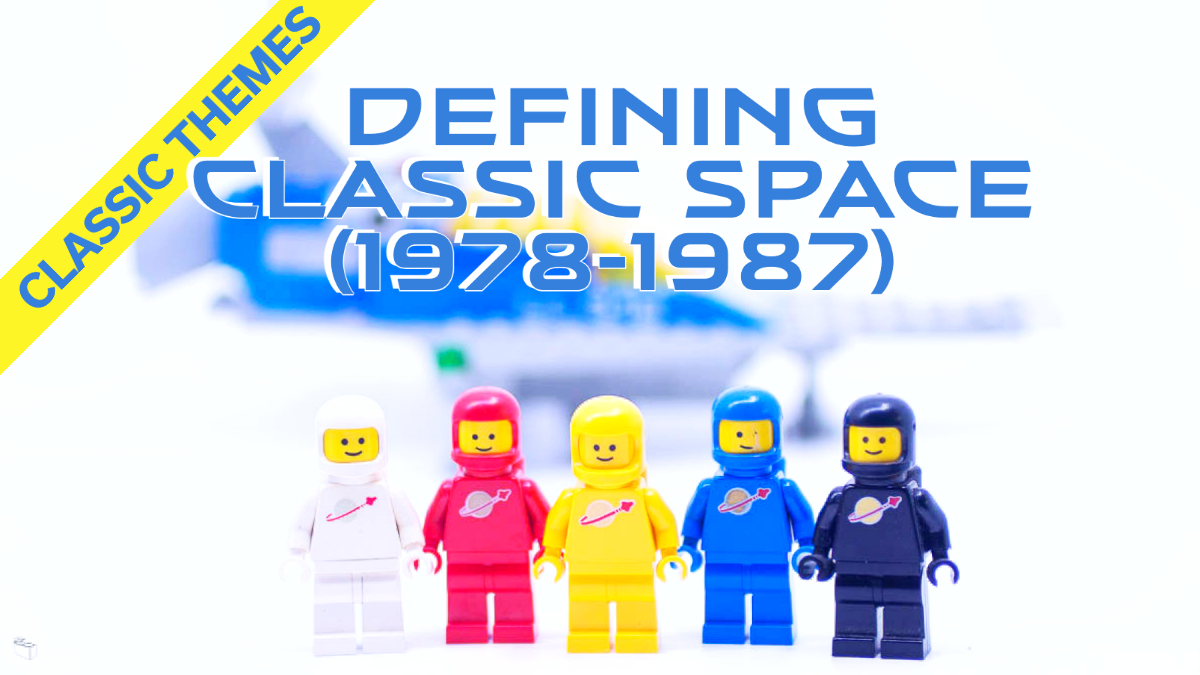
The recent arrival of the 2022 LEGO City Space sets has left some people myself included, wondering if the spirit of Classic Space has returned, while others remained unsatisfied, stating reasons of not enough blue and grey, an absence of transparent yellow, or that the blue in the windscreens was just not dark enough. But what does Classic Space actually mean?

Virtually everyone will agree that the period began in 1978, with the release of the first LEGO Space sets to feature minifigures. But when does it end? And what is it that makes those sets ‘Classic Space?’

Continue reading

Whatever Happened to Classic Town Part III: Into The Dark Ages

Welcome back to our exploration of classic themes. When we last visited LEGO Town, it was in the process of becoming juniorized. The Classic Town that many had grown up with was becoming an almost cartoonlike parody of itself. From 1978 through to the early ’90s, Town had a certain degree of simplicity, but with style. It was always striving to be its best, held back by the limits of the system, rather than the ability of the builder.

During the ’90s we saw the diversification of design: elements were used across many themes, we saw a broadened colour palette, and as time went by, we saw more themes/subthemes depicting aspects of contemporary life: Paradisa, Divers, Race, Outback, Arctic, Spaceport, Extreme Team and Res-Q. Towards the end of this era, the traditional town sets – fire, police, construction – were labelled ‘city’ and we saw a juniorization of some of the sets; a reduction in complexity, and perhaps a slight step away from attempting a realistic appearance.

Continue reading

Whatever Happened to Classic Town? Part 2: 1992-2000

Welcome back to our occasional series examining ‘Whatever Happened to Classic LEGO Themes?’ Previously, we took a look at the Classic town sets from 1978-1990.

We examined the way that the theme was defined by certain colours, shapes, and how a gradually expanding parts palette resulted in an evolution in the design of sets during this period. In 1978, when the LEGOLAND branded sets were first released, along with LEGO Minifigure, this was the theme set in the present, the real world, containing subject matter that kids could relate to: LEGO Town was set in the contemporary world, bringing kids experiences they could understand.

In this article, we shall trace the development of these ’Real World’ LEGO sets during the ‘System Era.’ The ‘System’ label, with the red 2×4 in place of the arm on the letter ‘T,’ was used to distinguish the other brick systems used in LEGO construction toys at this time: DUPLO and TECHNIC. The mark appeared in the upper left corner of the front of LEGO Boxes, to the right of the LEGO logo. This label appeared on LEGO Sets released from 1992 to 1999.

Continue reading

The Faces of LEGO 2021: Setting A Baseline For Gender Representation In Marketing ‘Hero Shots’

Earlier this week, the LEGO Group celebrated the UN’s International day of the Girl by releasing new research revealing that girls are ready to break free from traditional gender stereotypes, while the rest of society perpetuates these stereotypes. I shall post the press release at the end of this article.

Essentially, girls are ready to take on most of the activities in society, but there are societal stereotypes that result in both parents and their male peers potentially holding them back. This can potentially influence the career paths that they may embark on as they grow up.

Following up from this information, The LEGO Group have committed to making LEGO Play more inclusive, and ensuring that children’s creative ambitions are not limited by gender stereotypes:

“We know there is work to do which is why from 2021 we will work closely with the Geena Davis Institute on Gender in Media and UNICEF to ensure LEGO products and marketing are accessible to all and free of gender bias and harmful stereotypes.”

“We acknowledge our responsibility in having contributed to gender stereotypes over the years, which is why we’re actively addressing the challenges that gender biases create and we’re committed more than ever to do our bit to put it right. “

In this article, I will aim to look at the current gender biases present in the Hero Shots as depicted on LEGO.com in October 2021.

Continue reading

Whatever happened to Classic Town? Part I: 1978-1990

This year, I am looking at how LEGO Themes developed from those early days in 1978. Castle, Town and Space all developed in their own way, and they certainly don’t look the same today as they did back then! So as we take a ramble down Memory Lane, let’s look at how things were and how they have changed: scale, elements, colours and more.

For our first theme to track through time, I am looking at the theme that set out to represent the world around us: Classic Town. Over the years, this theme has evolved, with the LEGO City theme of today looking very different, yet incorporating similar subject matter. This investigation covers material released over more than 40 years. So it might take a little while. In this post, I shall cover LEGO Town from its origins in 1978 to 1990. Next time, we shall look at the System era (1992-1999). Finally, in the future, we will examine LEGO City and see how that theme compares with those in the early days. 

Along the way, we will examine the scale, building techniques, elements and more. There will be lots of pictures, sure to provoke a degree of nostalgia. I’d love to know which sets you feel fondly about and what you enjoyed about these themes.

Continue reading