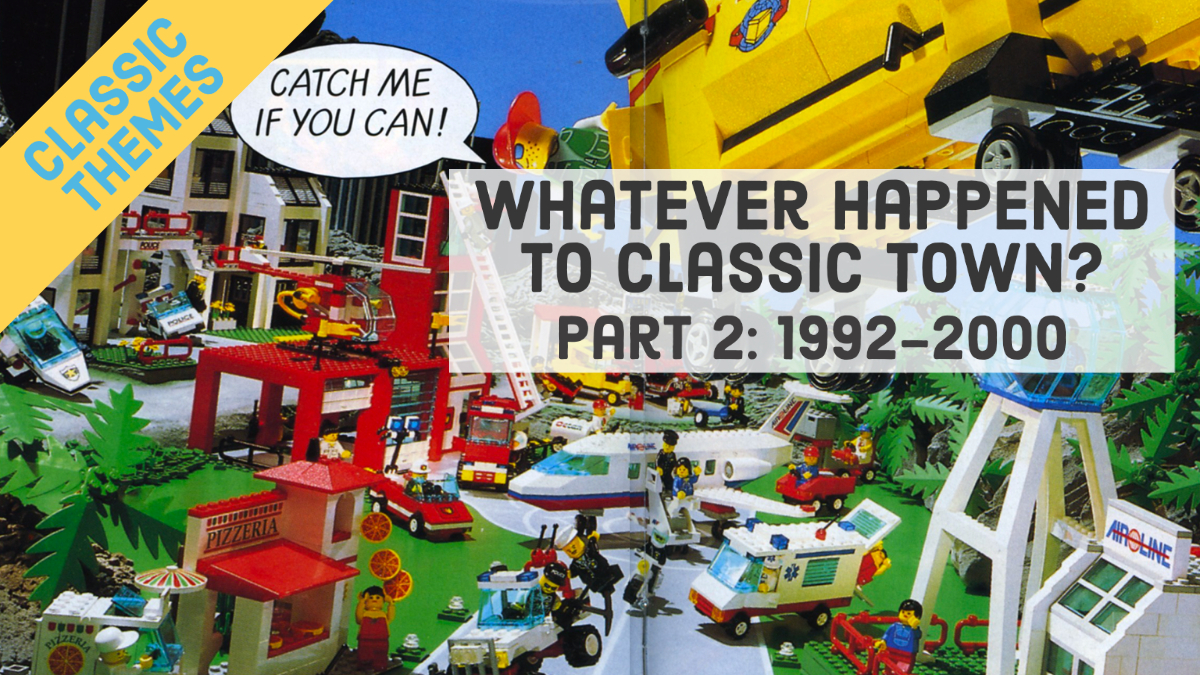
Whatever Happened To Classic LEGO® Themes? Part I: Prelude

The last time I was having a chat to adult visitors at a public exhibition (remember those?), something came up on more than one occasion: LEGO® Themes these days are not what they used to be. It used to be pretty simple – you’d build the set (and it was probably Town, Space or Castle. Unless you were a bit younger – then it may well have been a Pirates set) – and you’d pull it apart and build something else. It might be one of the alternate builds on the back of the box, it might be something completely different. It may not have even been related to the original theme.

These days, many sets thrive on 3rd party IP, and the majority of the in-house, story-driven themes are tied in with either an animated series or an overly complicated app.

For those of us yearning for a simpler time, in a world where things have become increasingly complicated, things are looking bleak! Unless you want to go straight to the 4+ sets.

Continue reading

Representation In Licenced LEGO® Themes with a Contemporary Cinematic Narrative II: LEGO® Harry Potter™

This is not a post specifically about LEGO® Harry Potter™. This is a post regarding the way in which the LEGO Group have chosen to represent female characters over time. I have chosen to use this theme, as it has had 2 distinct phases of release: first in 2001-2012, a period that ran in parallel with the release of the Harry Potter movies, while the second began in 2018, and continues to this day.

This my the second article is a series, looking at gender distribution of minifigures in licensed themes – themes where the LEGO Group has little say over the content of the source material. The first, relating to such trends in LEGO Star Wars sets can be found here

Continue reading

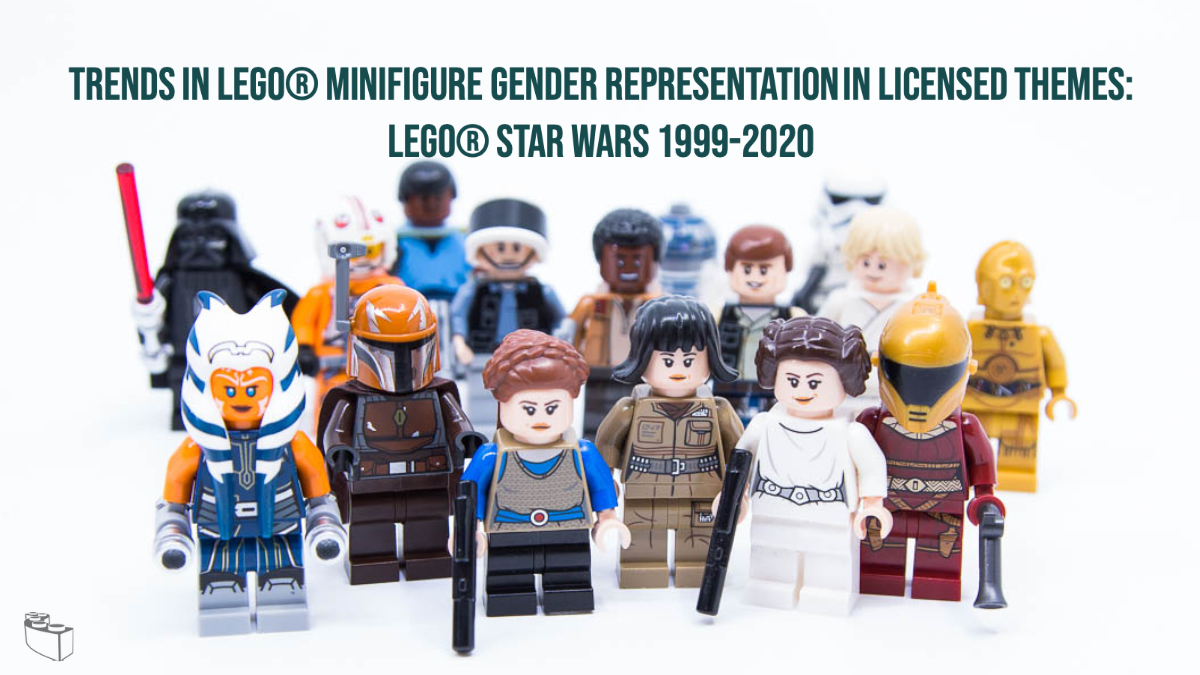
Trends in LEGO Minifigure Gender Representation in Licensed Themes I – LEGO Star Wars

This post has been coming for a little while. There is some history along with a rabbit hole or two: A week or so ago, it was International Women’s Day. In the past, I have written up some articles looking at the trends in gender representation in different LEGO themes over time. This year, I thought I would take a quick look at a couple of licensed themes and see how representation of female characters has changed over time. When I say representation, I probably really just mean ‘how many are presented to us in sets.’ I started with Harry Potter, Marvel and Star Wars. That’s actually quite enough.

In fact, I decided to leave it at that: ‘It shouldn’t take too long,’ I thought to myself. ‘Probably by tea time.’ It turns out that individual definitions of ‘not too long’ and ‘tea time’ might vary.

In the past, an annual update typically took about a day or so to complete. Of course, I failed to take into account that LEGO Star Wars has been running for over 20 years, and has had over 1000 different minifigures (including small, brick-built droids) associated with the theme over this time. Harry Potter has been running on and off for a similar period, albeit with a hiatus from 2012 – 2018. I have opted to present this information in a couple of articles. But before we begin, some background…

We have observed in recent years, since the introduction of LEGO® Friends, that the gender ratio of minifigures in LEGO City has become more balanced. In 2011, only 6 out of 64 minifgures released in the City theme were clearly defined as female (9.3%), while 23(36%) were clearly male. Thirty five of these figures were not clearly defined. Come forward to 2016, when I first examined this data: 41 minifigures out of 145 were clearly female (28%), while 61 were clearly male (42%). Last year, the situation was far more balanced: in the first half hear release of LEGO City, 35.3% of minifigures were female, 38.2 were clearly male and 26.5% of figures did not have clearly defined gender characteristics. This is focussed on figures released at that time. If you looked at LEGO City and Creator sets displayed in the print catalog for 1st half year 2020, the gender ratio was closer to 40%male; 40%female and 20% not clearly determined.

LEGO® Star Wars

Now, the Star Wars franchise has always had few issues as far as gender balance amongst the characters depicted on screen is concerned: With Aunt Beru, Leia, Mon Mothma, a few patrons in the Cantina and a couple of dancing girls in Jabba’s Palace being the only characters that stand to develop any form of story in the original trilogy – be it in the films, or extended universe.

The Prequel Trilogy (1999-2005) was not significantly better, with Amidala and her handmaidens, along with Shmi Skywalker being the primary female characters engaged in the narrative. A couple of silent female Jedi are present onscreen, but do not gain their voices in The Clone Wars. There is the bounty hunter Zem Wessel, but she is killed by Jango Fett before she extends to a second page of dialog. We do meet Aunt Beru, and she is the only one of these characters to survive past the end of The Revenge of the Sith!

The Sequel Trilogy (2015-2019) had a greater number of female characters central to the story, particularly Rey, but there were others, including Rose and the Stormtrooper Captain Phasma.

But it is outside the Skywalker Saga: The Clone Wars, Rebels, Resistance, as well as Rogue One and Solo and, more recently, the Mandalorian that we see and increased number of interesting characters – including some strong female characters such as Asohka Tano, Hera Syndulla, Bo Katan, Sabine Wren and Jyn Erso, as well as speaking roles being given to Jedi who otherwise remained fairly quiet during the prequel trilogy. We also gain an insight into societies beyond the points of central government, as well as some of the different forms of political intrigue across the galaxy. I am grateful to my son for encouraging me to go back and watch these series that I might have missed at the time of their original screenings.

Minifigures have also appeared over the years tied into Electronic arts Star Wars Games (Knights of the Old Republic; Battlefront), as well as novelties tied into animated specials and advent calendars.

So, how have things changed over the years?

Over the years, we have seen a few changes in LEGO® Star Wars!
Continue reading

An Ice Place To Be: Revisiting Ice Planet 2002

The recent Fan Vote for a 90th Anniversary set that has taken place on LEGO Ideas has reminded many of us of many of the great themes that LEGO sets have explored over the years. While Classic Space, Castle, Bionicle and Pirates were the themes that the public were most fond of, there were a number of other themes that we were reminded of. One of these was Ice Planet 2002: released in 1993-94. My friend Jay, over at Jay’s Brick Blog made an impassioned call for voting for this theme, but alas, it was unsuccessful. But there is no doubt that it is a theme that has its stalwart fans: certainly it has a striking aesthetic,so I thought I would take a closer look, to see what the theme brought to the Space sets at the time, as well as why it might be deserving of some greater love going forward.

Continue reading

What if they introduced a new Technic pin, and nobody noticed?

While putting together the Colosseum, reader JdV noticed that the black Technic pins joining together parts of the base were not the same as the Black Technic friction pins that he had come to know and love over the past 30 or so years. He then asked me what I knew about it?

Nothing. so I took a closer look at the element, and saw that it had some definite differences in design.

But is it significantly different? Is it functionally different? And can we fathom why it has been introduced? I dove headfirst into the Brickset database, pulled out my trusty Macro Lens and Digital Micrometer, and set about my investigations…

I went back to where the initial query began building the Colosseum:

Continue reading

Gender Balance in LEGO® City: 2020 Update

March the 8th marks International Women’s Day, and I thought I would briefly return to my occasional analysis of Gender Balance in LEGO® City. I haven’t visited the topic for a couple of years, and was wondering if there have been significant changes here.

Continue reading

The Aged Fate of 6000 Ideas Book’s Bill and Mary: Conclusion, Speculation and Outrageous Fan Theories

In which we try to tie up the loose ends, identify our heroes, and after one thing leads another, discover something we never set out to.

For almost a year, now, I have been exploring the potential for ongoing adventures of Mary and Bill – these minifigures first appeared in the 6000 Ideas Book, published in time for Christmas 1979. We started off looking at the 6000 Ideas Book itself, covering the story set in the town, and then the weird space bit, along with the Castle bit.

I asked a Big Question: Could Mary and Bill still be found in the world of LEGO City today? For characters to survive nearly 40 years, we would need to be confident that we see story telling occurring within the in-house themes, that characters see development over the course of years, and that they have the potential to cross themes, as Bill and Mary did in the book, and indeed would need to to move from Book characters to LEGO City.

Continue reading

After 6000 Ideas: The Legacy of Bill and Mary 1981-1990

In which we attempt to follow the trail of Mary and Bill, after events of the 6000 Ideas book. We look through subsequent Ideas books and move to the Adventures of Captain Indigo, featured in Bricks n Pieces magazine in the 1980s

Let me tell you a story. It has been a little while since we have visited the world of the 6000 Ideas Book, but I have not forgotten where we are heading. So, here is a recap:

Continue reading

In search of Bill and Mary II:

Evidence for character development within and between LEGO Themes.

In which I go in search of changes that occur to characters within LEGO themes, and in search of characters moving between themes – as we continue to look out for evidence that the central characters in the 6000 Ideas Book: Bill and Mary to some, Indigo and Polkadot to others, can be seen to continue their life in LEGO City today.

The LEGO Ideas Book 6000 was released in time for Christmas, 1979. As such, I am celebrating its 40th birthday throughout the year. I have been particularly curious to see whether the main characters of this delightful childhood memory could possibly exist in LEGO City today. I would expect to find them much older than they were 40 years ago, to say nothing of a possible variation in how they dressed. However, LEGO City is not quite the same as LEGO Town. SO: I have been looking for evidence of specific characters appearing over multiple years within a theme, or potentially changing themes. If a character has been around for years, I have been looking for evidence of development – physical, or chronological. Do they look older? Have they changed in any way – sporting evidence of long term injury and so forth.

Continue reading

The Search For Bill and Mary I

Long Term Character Development in LEGO Town and City.

In which we begin our ongoing search for Bill and Mary, by looking through LEGO Town and LEGO City for evidence of long form story telling, beyond the confines of a single set. If we can find it, then we are one step closer to demonstrating whether or not the protagonists of the 6000 Ideas Book could still exist in LEGO City today…

Continue reading